Generative AI in Local Government: Building the New Muscle Memory (Part 1: 3 Field-Tested Prompts & Workflows)

Back in late 2023, I published a piece titled Generative AI: A Practical Guide for Local Government Transformation. At the time, ChatGPT was barely a year old, Google had just unveiled Gemini 1.0, and the conversation across public sector leadership was largely conceptual: What is this thing? What might it look like down the road? Can we trust it?
Fast-forward three years. The underlying technology did not just evolve; it took off like a rocket.
Today’s models can reason across thousands of pages of municipal code, cross-reference messy zoning regulations, translate constituent communications into dozens of languages, and analyze roadway imagery for infrastructure defects.
Yet, when I look at the local government landscape, talking with mayors, county commissioners, clerks, and department heads across Indiana and beyond, a stark reality hits you:
The capability gap versus actual adoption in local government is wider today than it was in 2023.
Right now, public discourse is saturated with doom and gloom about artificial intelligence. Every week brings another headline about catastrophic risks and runaway technology. As a thoughtful Semafor piece on technology fears recently pointed out, existential panic around new technological breakthroughs is not unprecedented. History is full of moments where society feared the worst about powerful innovations.
Make no mistake: safety, ethics, and clear guardrails are critical. We have to be responsible custodians of public trust. But I am choosing to focus on the good: the massive boom in productivity, discovery, and practical problem-solving. This technology has the potential to eliminate soul-crushing administrative toil and help us tackle real challenges, from public health to responsive neighborhood services.
So why is adoption lagging so far behind in local government? Let’s be honest about the ground reality.
Cities and counties are the backbone of our communities. They patch the streets, manage emergency services, run public health clinics, and process the permits that keep local economies moving. But they do it on razor-thin budgets with small, stretched teams. They do not have dedicated innovation labs or seven-figure consulting retainers. When enterprise tech vendors show up pitching complex, multi-year software deployments, local leaders rightly push back.
If we wait for traditional enterprise software procurement cycles to modernize local government, our communities will wait years.
The good news is that you do not need an expensive vendor contract or a team of computer scientists to unlock real value. You just need to build a new muscle memory.
AI is a Muscle Memory, Not a Software Purchase
Whenever I talk with public sector teams about technology, I share this simple truth: AI is fundamentally different from buying a piece of software.
When you purchase financial accounting software or a new 311 ticketing system, you learn where the buttons live, migrate your records, and repeat the same deterministic clicks every day. You press button A, and you always get result B.
AI does not work that way. AI is a partner in cognition. It is a tireless assistant sitting beside you that can read at superhuman speeds, draft clean prose, and synthesize complex documents in seconds. To get value out of it, you have to develop a new instinct, alongside your judgment.
Professor Ethan Mollick often describes this dynamic as the “jagged frontier” of artificial intelligence. AI can perform astonishing, PhD-level analysis on a complex legal text one minute, and then make a silly, rookie mistake on a simple factual detail the next.
Computers have trained us for sixty years to expect deterministic outcomes. AI is probabilistic. That single shift requires a completely different mental posture. You cannot blindly trust it, but you also cannot afford to dismiss it.
Throughout my career working alongside public servants, listening to city managers, clerks, and directors wrestle with operational headaches, and in my day job at Google supporting public sector teams, I see how easy it is to fall back on old habits:
- “I need to comb through these two 60-page state bills to see where they touch our municipal ordinances.” (Pause. Why am I reading this line by line with a yellow highlighter? Let the model do the first-pass comparison.)
- “I have to draft three separate versions of this public hearing announcement for different neighborhood groups.” (Pause. Why am I staring at a blank screen?)
Building that muscle memory takes intentional, daily practice. It means training yourself and your team to ask: Can an AI take the first pass at this?
Notice the phrase: the first pass.
We are never talking about handing over civic authority to an autonomous system. Human public servants must remain firmly in the loop: acting as the editor, the subject matter expert, and the accountable decision-maker. AI simply absorbs the repetitive grunt work so staff can spend their energy serving residents.
A Critical Note on Data Security & Privacy
Before you paste municipal information into any AI tool, know your guardrails. Never input sensitive, confidential, or citizen personally identifiable information (PII) into free, consumer-grade chatbots. Unless your city or county is operating under enterprise commercial terms of service that explicitly guarantee data privacy and protect your inputs from being used to train public models, stick strictly to public records (such as published meeting transcripts, enacted state statutes, and public zoning codes).
If you are unsure how to set up proper security guardrails or want to know how to deploy these tools safely under enterprise terms, reach out to me through my contact page. I am always happy to help local leaders think through how to do this the right way.
Playbook 1: City Council & County Clerk (Meeting Records to Constituent Access)
Where Things Bog Down
Public meetings are the front door of local democracy. But for a City Clerk or County Auditor, they represent an administrative marathon. A three-hour council meeting frequently requires six to ten hours of manual transcription, formatting, and proofreading.
Because clerical teams are stretched thin, official minutes can take weeks to finalize and post. When they finally go live, they sit inside dense, multi-page PDFs that very few residents ever read. If your community includes a growing non-English speaking population, that civic barrier is even steeper.
A Shift in Daily Habit
Stop treating meeting documentation as a manual typing chore. Shift your posture from transcriptionist to editorial director.
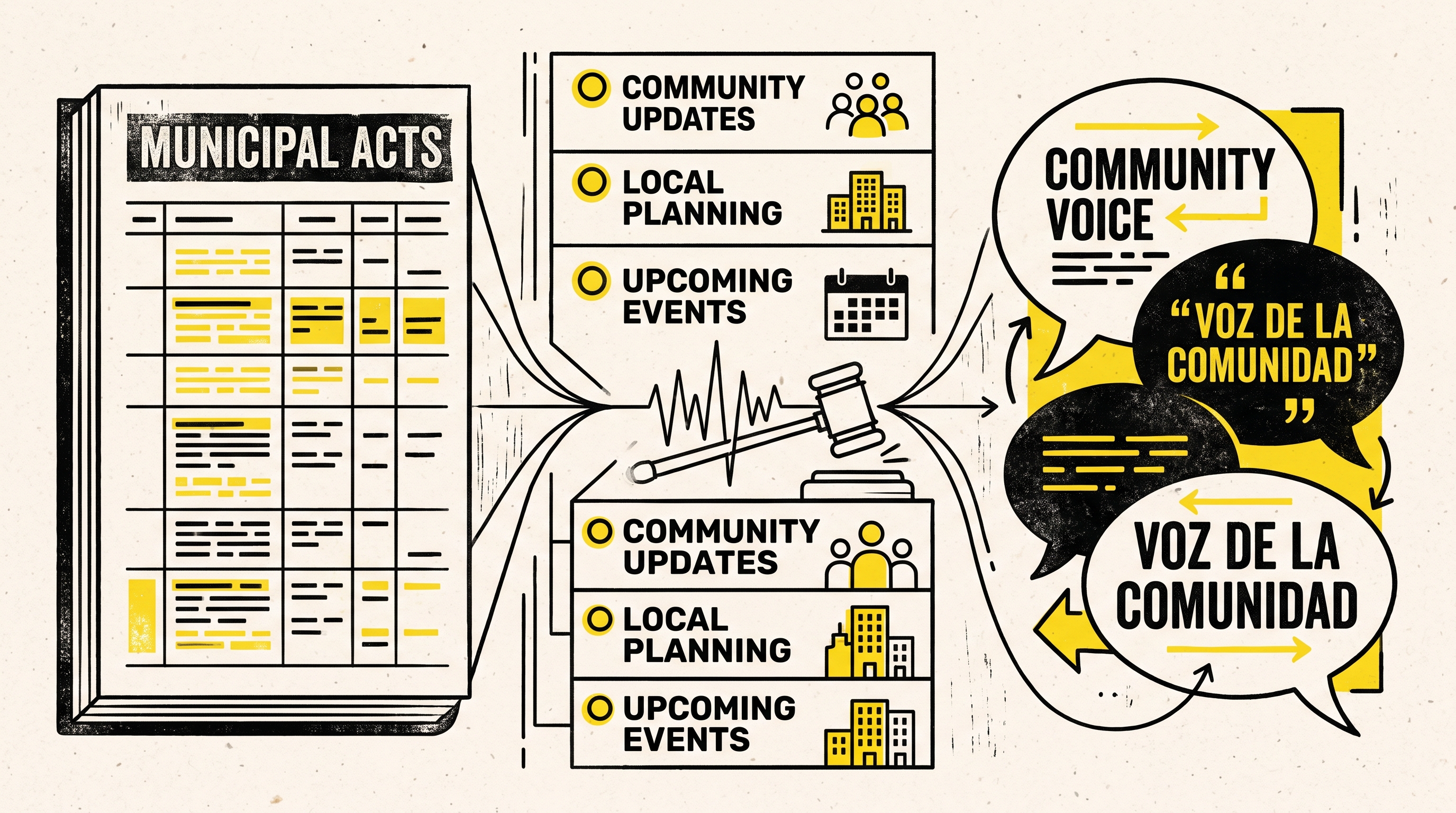
By pairing your automated meeting transcript with a tailored system prompt, an AI tool can process the conversation and deliver three distinct, synchronized outputs in one pass:
- Formal, neutral meeting minutes tracking motions, seconds, and roll-call votes.
- A three-bullet civic recap written in plain language for your website or newsletter.
- An accurate Spanish translation ready for community distribution.
Pro Tip for Clerks
Keep your handwritten roll-call sheet handy. Chamber audio can be imperfect when members talk over each other or turn away from their microphones. Let AI handle the formatting and heavy synthesis, but always verify motions and vote tallies against your official tally sheet. And as always, remember that these remain draft minutes until the council or commission formally votes to adopt them at the subsequent meeting.
Starting-Point Prompt
Think of this prompt as an adaptable foundation. Building your AI muscle memory means continually testing, tweaking, and tuning your prompts over time to match your community’s specific council rules and publishing standards.
You can paste raw text into the placeholder below, or simply upload your transcript file directly alongside this prompt in your AI tool of choice.
You are an expert Municipal Clerk and Public Information Officer for [INSERT CITY / COUNTY NAME]. Your job is to process raw meeting transcripts into official municipal records and accessible constituent communications.

Review the attached meeting transcript and produce THREE distinct outputs adhering strictly to the guidelines below:

### OUTPUT 1: OFFICIAL MEETING MINUTES
- Identify the meeting body, date, and presiding officer.
- Extract every formal agenda item, motion, second, and roll-call vote count.
- Maintain a neutral, official record-keeping tone following [INSERT PROCEDURAL RULES, e.g., Robert's Rules of Order or Council Rules of Procedure]. Do not editorialize.
- List action items assigned to municipal staff with explicit deadlines if mentioned.

### OUTPUT 2: PLAIN-LANGUAGE CONSTITUENT RECAP
- Write a 3-bullet summary written at an 8th-grade reading level.
- Focus on what directly impacts residents and taxpayers (e.g., utility rates, speed limits, park rules, public hearings).
- Keep each bullet under 35 words.

### OUTPUT 3: COMMUNITY SPANISH TRANSLATION
- Translate Output 2 into clear, culturally natural Spanish for our bilingual constituent newsletter.

---
TRANSCRIPT:
[PASTE RAW TRANSCRIPT OR ATTACH TRANSCRIPT FILE HERE]
Seeing It in Action
Sample Input (Raw Transcript Excerpt):
President Miller: Moving to Item 4B, the proposed Downtown Pedestrian Safety Ordinance 2026-14. Councilman Davis, your committee reviewed this?
Councilman Davis: Yes, Mr. President. It lowers the speed limit on Main Street between 1st and 8th Avenue from 30 to 20 mph and authorizes two raised crosswalks funded by the highway safety grant. We held two business owner hearings. I move to approve Ordinance 2026-14 on second reading.
Councilwoman Rodriguez: Second.
President Miller: Discussion? Hearing none, Clerk please call the roll.
Clerk: Davis? Aye. Rodriguez? Aye. Vance? Nay. Miller? Aye. Motion carries 3-1.
President Miller: Public Works Director Evans, please ensure signage bids are prepared for the October 15th study session.
Generated Output:
Output 1: Formal Minutes Entry
Item 4B: Ordinance 2026-14 - Downtown Pedestrian Safety
Councilman Davis presented the committee report regarding proposed speed reductions and traffic calming on Main Street (1st Avenue to 8th Avenue).
Motion: Councilman Davis moved to approve Ordinance 2026-14 on second reading.
Second: Councilwoman Rodriguez.
Vote: Ayes: Davis, Rodriguez, Miller (3). Nays: Vance (1). Motion carried 3-1.
Staff Directive: Public Works Director Evans was directed to prepare signage installation bids for the October 15, 2026 study session.Output 2: Plain-Language Constituent Recap
- Main Street Speed Limit Lowered: Speed limits between 1st and 8th Avenues will drop from 30 mph to 20 mph to protect downtown pedestrians.
- New Raised Crosswalks: Two elevated crosswalks will be installed this fall, funded entirely through a state highway safety grant with zero local tax impact.
- Next Steps: Final contractor bids for new signage will be reviewed at the October 15 public study session.
Output 3: Community Spanish Translation (Resumen Comunitario)
- Reducción de velocidad en Main Street: El límite de velocidad entre la 1.ª y la 8.ª Avenida se reducirá de 30 a 20 mph para proteger a los peatones en el centro.
- Nuevos pasos peatonales elevados: Se instalarán dos cruces elevados este otoño, financiados completamente por una subvención estatal de seguridad vial sin costo para los contribuyentes locales.
- Próximos pasos: Las propuestas de contratistas para la nueva señalización se revisarán en la sesión pública del 15 de octubre.
Playbook 2: City Attorney & Administration (State Legislative Impact Audit)
Where the Friction Hits
Every spring, state legislatures wrap up their sessions by passing massive omnibus bills. These statutory changes ripple directly into local authority, covering everything from accessory dwelling units and zoning preemption to municipal bidding thresholds and public notice rules.
For a City Attorney or County Counsel with just one or two deputies, cross-referencing a 250-page legislative act against an 800-page municipal code is grueling. Crucial discrepancies often hide in the weeds until an applicant or developer files an administrative appeal.
A New Research Partner
Do not attempt to reconcile legislation line by line in a vacuum. Treat AI as a tireless legal research clerk.
By loading your relevant municipal code chapters alongside the newly enacted state statute into an AI model or a grounded research tool like Gemini Notebook (formerly NotebookLM), you can generate a Statutory Conflict Matrix. The model surfaces direct contradictions, drafts redlined amendatory language, and produces an executive briefing memo for council leadership.
Starting-Point Prompt
Customize this baseline with your state’s statutory citation conventions and local drafting rules.
You are a senior Municipal Attorney advising the City Council and City Manager of [INSERT MUNICIPALITY NAME].

Your objective is to review a newly enacted State Statute and identify its legal impact on our existing Municipal Code.

Compare the provided STATE STATUTE EXCERPT against our current MUNICIPAL CODE EXCERPT and deliver:

1. STATUTORY CONFLICT MATRIX (Markdown Table):
   - Local Code Section & Current Rule
   - State Statute Requirement
   - Conflict Level (Direct Conflict / Silent / Discretionary Local Authority)
   - Mandatory Local Action Required (Yes/No)

2. RECOMMENDED CODE REVISION:
   - Provide precise draft amendatory language showing additions in **bold** and deletions in ~~strikethrough~~ adhering to our local ordinance format.

3. COUNCIL BRIEFING MEMO:
   - A concise 2-paragraph executive summary explaining the operational impact, legal risk if unamended, and recommended timeline for council action.

---
STATE STATUTE EXCERPT:
[PASTE STATE LEGISLATIVE TEXT HERE]

MUNICIPAL CODE EXCERPT:
[PASTE LOCAL CODE CHAPTER HERE]
Seeing It in Action
Sample Input:
State Statute Excerpt (SEA 142, Effective July 1):
“No political subdivision may require more than one (1) off-street vehicular parking space per residential accessory dwelling unit (ADU) located within one-half mile of a public transit stop or designated public bicycle corridor.”Municipal Code Excerpt (City Code § 154.088 - Accessory Uses):
“All detached accessory dwelling units within residential zoning districts R-1 and R-2 must provide a minimum of two (2) paved, dedicated off-street parking spaces on the same parcel as the primary dwelling.”
Generated Output:
1. Statutory Conflict Matrix
Local Code Section Current Municipal Rule State Statute (SEA 142) Conflict Level Mandatory Action Required? § 154.088 (ADU Parking) Mandates 2 dedicated off-street parking spaces for all detached ADUs in R-1/R-2. Caps parking requirement at 1 space if within 0.5 miles of transit stop or bike corridor. Direct Conflict (State Preemption) YES. Existing 2-space mandate is legally unenforceable within qualifying transit corridors as of July 1. 2. Recommended Amendatory Language
§ 154.088 (B) Parking Requirements for Accessory Dwelling Units:
“All detached accessory dwelling units within residential zoning districts R-1 and R-2 must provide a minimum of two (2) paved, dedicated off-street parking spaces on the same parcel as the primary dwelling~~.~~, except that any accessory dwelling unit located within one-half (0.5) mile of an established public transit route stop or designated municipal bicycle corridor shall not be required to provide more than one (1) off-street vehicular parking space.”3. Council Briefing Memorandum
TO: Mayor and Common Council
FROM: Office of the Corporation Counsel
RE: Mandatory Compliance Amendment to Zoning Code § 154.088 (SEA 142)Senate Enrolled Act 142 takes effect July 1, establishing a statewide cap of one off-street parking space for accessory dwelling units situated near transit or bicycle routes. Our current zoning code requires two spaces across all residential parcels. Because state law preempts local authority on this matter, retaining our existing standard exposes the city to administrative appeals and potential fee-shifting liabilities.
We recommend introducing the attached amendatory ordinance at the upcoming May council meeting for first reading, followed by Plan Commission review, ensuring complete statutory compliance prior to the July 1 deadline.
Playbook 3: Planning, Zoning & Building (Permit Checklist Pre-Screening)
The Permitting Bottleneck
Ask local builders, commercial property owners, or homeowners about their biggest headache with municipal services, and the answer is almost universal: permitting turnaround times.
A commercial facade or signage permit that should take a few days frequently stretches to four or six weeks. But behind the scenes, plan reviewers are not moving slowly on purpose. They are drowning in incomplete applications. Over half of incoming packets lack required setback dimensions, omit structural attachment notes, or fail basic zoning formulas.
Each missing item forces staff to stop their review, draft an email, and wait. That back-and-forth completely clogs the review queue.
Rethinking the Intake Flow
Do not force a licensed plan reviewer to spend their time manually verifying checkboxes on an intake sheet.
Instead, build an automated pre-screening workflow. When an applicant submits plans and specifications, run the application data against your published department checklist. Within sixty seconds, the AI verifies basic mathematical formulas, checks setbacks, and generates either a clear deficiency letter for the applicant or a clean triage summary for staff. If a project clearly violates a setback or dimensional standard, the screener flags it immediately as a candidate for the Board of Zoning Appeals (BZA) variance docket, rather than letting it sit in a technical plan review queue for three weeks only to get bounced back.
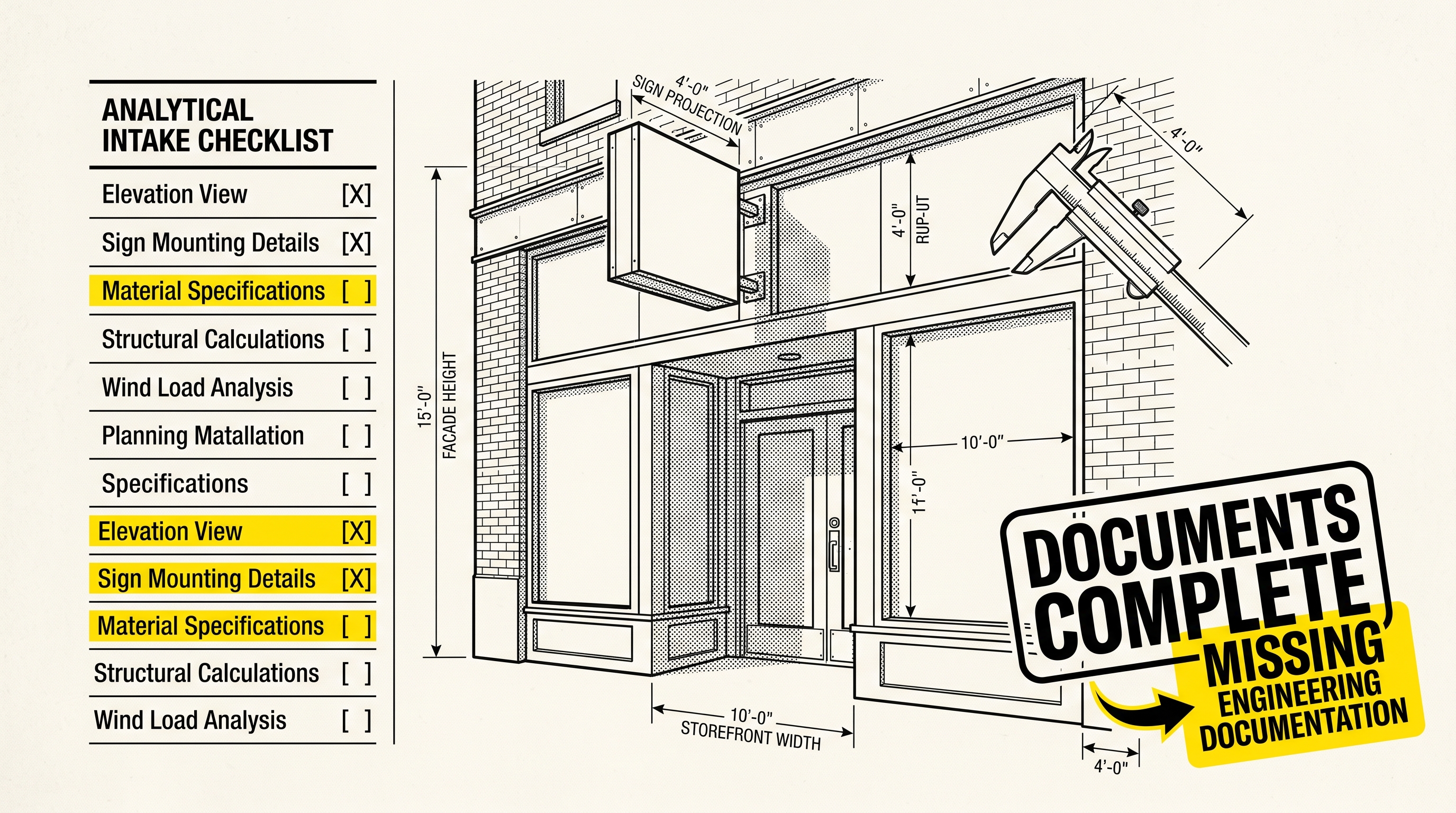
Turn a 30-day queue into a 48-hour triage.
Sidenote: Thinking Beyond the Chatbot
Here is an essential perspective check: our future with AI is not sitting in front of a web chatbot all day, typing prompts back and forth.
Chat windows are just the initial training ground where we learn how these models reason. The true transformation happens when AI is embedded directly into departmental workflows and back-office pipelines. Imagine your permitting portal running this compliance check automatically the instant an applicant hits “submit.” That is where real acceleration lives.
And remember the golden rule: the AI never approves or denies the permit. It simply ensures that when your human building commissioner or zoning administrator opens the packet, every piece of required documentation is present and accounted for.
Starting-Point Prompt
Adapt this template to reflect your local commercial or residential zoning codes. Encourage your team to experiment with adding local submittal requirements.
You are a Lead Municipal Permit Specialist and Zoning Plan Reviewer for [INSERT CITY / COUNTY NAME].

Evaluate the submitted PERMIT APPLICATION against our MUNICIPAL COMMERCIAL ZONING CHECKLIST.

Deliver the review in three structured sections:

1. INTAKE COMPLIANCE SCORECARD (Markdown Table):
   - Evaluated criteria (Setbacks, Sign Dimensions, Structural Specs, Clearance)
   - Status (Compliant / Non-Compliant / Missing Information)
   - Specific Municipal Code Citation

2. DEFICIENCY NOTIFICATION LETTER (To Applicant):
   - Professional, courteous, and helpful tone.
   - Bulleted list detailing exactly what is missing or non-compliant, explaining what must be resubmitted to proceed to formal technical review.
   - Exact local municipal code citation for each issue.

3. EXAMINER INTERNAL NOTES:
   - 2-sentence summary for the Building Commissioner highlighting any site-specific considerations, non-conforming lot conditions, or whether the applicant must be routed to the Board of Zoning Appeals (BZA) for a variance.

---
MUNICIPAL COMMERCIAL ZONING CHECKLIST:
[PASTE LOCAL PERMIT CHECKLIST & STANDARDS HERE]

SUBMITTED APPLICATION DATA:
[PASTE APPLICANT SUBMITTAL DETAILS HERE]
Seeing It in Action
Notice how this single prompt performs three jobs simultaneously: it builds an analytical scorecard, drafts customer-facing communication, and generates internal technical notes. That multi-output efficiency is where operational leverage truly compounds.
Sample Input:
Checklist Criteria (Downtown B-2 Commercial District - Signage & Facade):
- Max wall sign area: 1.5 sq ft per linear foot of building frontage.
- Projecting signs: Minimum 8 ft vertical clearance above sidewalk grade; maximum projection 48 inches from building wall.
- Illumination: External direct downlight only; no flashing or exposed neon.
- Required submittals: Dimensional scale drawing, mounting hardware spec sheet, wet-stamped structural wind-load calculation for projecting signs over 20 sq ft.
Applicant Submittal (Main Street Coffee Roasters, 142 W. Main St):
- Storefront frontage: 24 linear feet.
- Proposed Wall Sign: 28 sq ft aluminum composite sign with external gooseneck LED lighting.
- Proposed Projecting Blade Sign: Double-sided wood/steel blade sign, 24 sq ft total area (3’ x 8’), projecting 42 inches from wall. Mounting height: bottom edge is 7’ 2” above public sidewalk.
- Attachments: Elevation drawings and hardware bracket specs provided. No engineering stamp included.
Generated Output:
1. Intake Compliance Scorecard
Item / Requirement Submitted Spec Allowed / Required Standard Status Code Citation Wall Sign Area 28 sq ft 36 sq ft max (24 ft frontage × 1.5) Compliant § 156.04(A) Wall Sign Lighting Gooseneck LED downlight External direct downlight permitted Compliant § 156.04(D) Blade Sign Projection 42 inches from wall 48 inches maximum projection Compliant § 156.05(B) Blade Sign Clearance 7 ft 2 in above sidewalk 8 ft 0 in minimum clearance NON-COMPLIANT § 156.05(C) Structural Engineering Not provided in submittal Wet-stamped wind-load calcs required for projecting signs > 20 sq ft MISSING INFO § 156.09(F) 2. Applicant Deficiency Notice
City of Hopewell - Department of Planning & Building Services
Permit Application Intake Review: #BP-2026-0419 (142 W. Main Street)Dear Applicant,
Thank you for submitting your commercial signage permit application for Main Street Coffee Roasters. Your submittal has completed initial intake triage. Before this application can be forwarded to the Building Commissioner for final technical review, the following two items must be resolved:
- Sidewalk Vertical Clearance (§ 156.05(C)): Your proposed projecting blade sign indicates a bottom clearance of 7 feet 2 inches above the sidewalk. Municipal code requires a minimum clearance of 8 feet 0 inches to prevent hazard to pedestrians and maintenance equipment. Please adjust your mounting elevation.
- Structural Engineering Calculation (§ 156.09(F)): Because the proposed projecting blade sign measures 24 sq ft (exceeding our 20 sq ft threshold), please provide a signed and sealed structural engineering calculation verifying wind-load resistance for the wall-bracket mounting assembly.
Please upload your revised elevation drawing and engineering documentation through our online permit portal. Once uploaded, your application will immediately advance to technical plan review.
3. Examiner Internal Notes
Intake flagged an overhead clearance violation (7’2” vs 8’0” req) and missing structural engineering verification for a 24 sq ft projecting sign in a pedestrian corridor. Because the applicant cannot achieve 8’ clearance due to building awning architecture, recommend routing applicant to the Board of Zoning Appeals (BZA) for a developmental variance if redesign is infeasible. Application held at intake triage; applicant notified within 24 hours of submittal.
Where We Go From Here
Take a moment to step back and look at what these three playbooks actually accomplish.
None of them required buying a six-figure proprietary software suite. None of them required hiring an outside consulting firm or standing up complex server infrastructure.
They simply take the everyday, unstructured documents that local governments handle every single morning (meeting transcripts, statutory bills, and permit applications) and apply structured instructions to do the heavy administrative lifting.
It is about speed. It is about dignity for hardworking municipal staff. And above all, it is about delivering responsive, timely service to the citizens who count on us.
In Part 2 (coming soon), we tackle the strategic and organizational side of this journey:
- How local governments on tight budgets can adopt AI safely without new software costs (leveraging platforms you likely already own, like Google Workspace and Gemini Notebook).
- How to navigate public records disclosure, data custody, and compliance without fear.
- How to prepare your city or county for the incoming wave of high school and college graduates who are entering the public sector workforce as native AI users.
Until then, grab one of the prompts above. Open Gemini, Claude, or ChatGPT. Paste in an actual meeting transcript or zoning excerpt from your own community, and see how it performs.
What do you think? What is the single biggest administrative bottleneck in your municipality right now? Drop a note in the comments below. I would love to hear what you are experimenting with and how it is working in the field.
Join the conversation