The Hidden Tax of 100% Chargeback in State Government IT
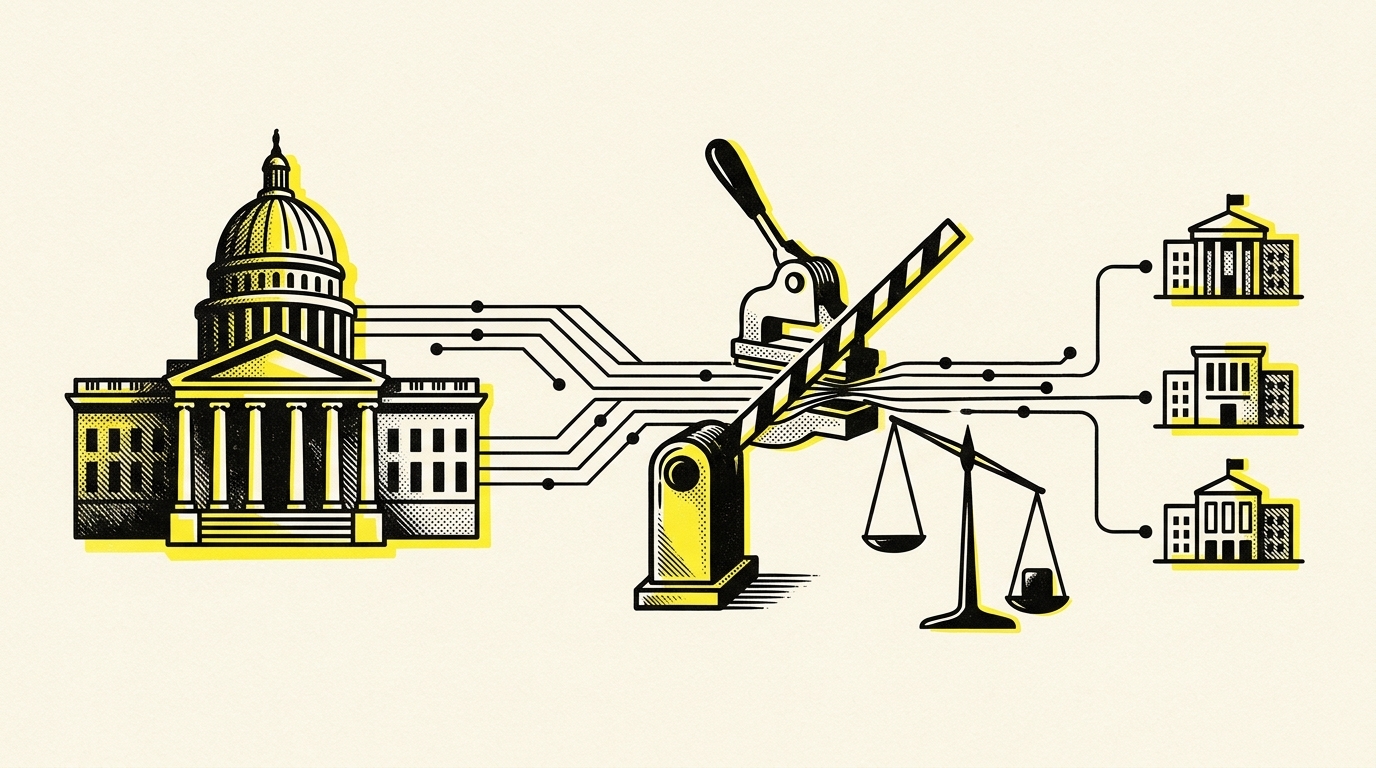
Imagine running a state government with dozens and dozens of agencies (transportation, health, revenue, public safety) and letting each one negotiate its own contracts with hyperscalers and large technology vendors.
Dogs and cats living together… mass hysteria! Zero buying leverage. Wildly inconsistent security.
On paper, centralizing state IT makes complete sense. In my 20 years in tech, most of it alongside public-sector teams, I’ve seen why states pull shared technology under one roof.
Here’s the thing: centralizing state government IT isn’t the problem. Funding it predominantly through a chargeback model is.
When Central IT receives little or no direct appropriation, it’s forced to operate like an internal reseller, tacking overhead onto the services it bills back to agencies just to cover staff and legacy infrastructure. That single budget mechanic creates a hidden tax on modernization that taxpayers pay either way.
Credit Where It’s Due: What Central IT Gets Right
Central IT isn’t inherently a bad idea. Every state needs foundational capabilities negotiated once and managed consistently:
- Enterprise buying leverage with hyperscalers and large technology vendors.
- Shared productivity and collaboration suites so agencies can actually work together.
- Core plumbing: statewide networking, domains, DNS, identity management, and baseline cybersecurity.
- Everyday workplace tech and hosting: enterprise telephony, standard devices, conference room equipment, and common hosting foundations.
Asking dozens of agencies to reinvent DNS or buy overlapping office software wastes public money. The trouble starts with how Central IT pays its own bills.
The Chargeback Trap: Good People Inside a Broken Loop
According to NASCIO’s 2023 State CIO Survey, 90% of states use chargebacks at least partially, and roughly three-fourths of those rely on agency billing for over half their revenue. Even where states receive some general funds (63% do), that slice often covers just the CIO’s office, GIS, or a narrow security line while core operations live or die on agency invoices.
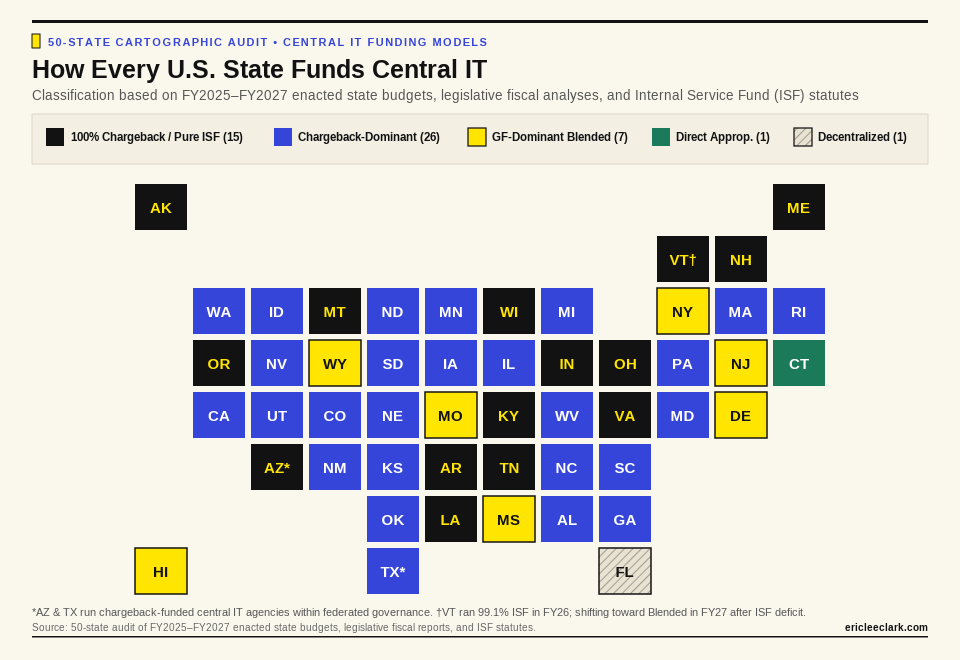
I had AI research and analyze FY2025–FY2027 enacted state budgets and Internal Service Fund (ISF) statutes across all 50 states, and the data backs this up: 41 of 50 states (82%) run Central IT on either a 100% Chargeback / Pure ISF model (15 states) or a Chargeback-Dominant Blended model (26 states), with at least 24 states drawing 85% to 100% of their budget from agency billing.
Let me be clear: I’m not knocking state IT staff. They’re dedicated public servants keeping critical systems upright under tough constraints. The problem isn’t the people. It’s the incentive structure.
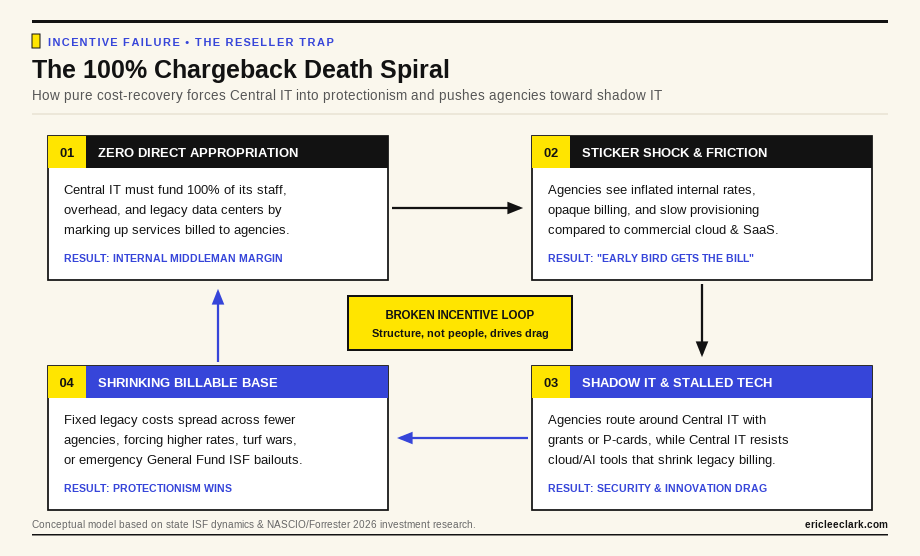
When your budget and headcount depend on acting as a middleman, there’s almost zero structural incentive to run lean or automate overhead. If modernizing a workload retires legacy hosting or reduces the hands-on infrastructure support hours Central IT bills to agencies, you’re effectively cutting the revenue stream that pays your team. Protectionism becomes a survival reflex.
In practice, that broken loop hits states in two painful ways:
- Reluctance to adopt modern cloud, SaaS, and AI. NASCIO’s latest annual surveys (NASCIO Resource Center) show AI now ranks #1 on state CIO technology priorities and 82% of states already run generative AI in production, yet only 28% have dedicated AI funding streams. As Forrester and NASCIO’s 2026 investment research puts it, rigid cost-recovery creates “the early bird sometimes gets the worm, but always gets the bill.” No single agency wants to eat the upfront cost and risk of pioneering a modern shared platform while legacy billable infrastructure sits untouched.
- Shadow IT and the “death spiral.” When agencies compare marked-up internal rates and slow provisioning against commercial cloud or SaaS, sticker shock sets in. Program leaders route around Central IT with operational funds, grants, or procurement cards, fueling shadow IT and real security blind spots. Worse, as agencies walk away, fixed legacy costs get spread across fewer remaining customers, pushing rates even higher.
We’re already watching this break in real state budgets. In one New England state running a ~99% chargeback fund, unbillable enterprise and security costs drove the IT fund toward a projected $28 million deficit, forcing an emergency General Fund bailout and a pivot toward direct appropriations anyway. In a large western state, cloud migration shrank legacy data-center billing so fast that lawmakers had to step in to stabilize rates and move cybersecurity onto direct General Funds.
When a funding model needs emergency bailouts just to survive modernization, the model is telling you something.
The “Color of Money” Illusion
In state government, we love talking about the color of money. On a spreadsheet, 100% chargeback looks tidy: “We’re holding agencies accountable for what they consume!”
Let’s be honest. Taxpayers pay for state technology either way.
Routing tax dollars through dozens of agency budgets so agencies can pay marked-up invoices back to Central IT doesn’t save a dime. It just burns staff hours on rate disputes.
There is one legitimate fiscal reason states built chargebacks: federal matching dollars. Agencies like health and human services, transportation, and labor rely on major federal grants. Under 2 CFR Part 200, Appendix V, documented IT charges supporting federal programs qualify for federal reimbursement. Ignore that and you leave millions on the table.
Here’s the good news: you don’t need a 100% chargeback model to capture federal match. Federal rules distinguish billed central services (for variable, agency-specific usage) from allocated central services, where states recover indirect enterprise IT overhead through an annual Statewide Cost Allocation Plan (SWCAP).
A Better Way: Blended Funding (From Reseller to Strategic Broker and Enabler)
If 100% chargeback breeds protectionism, and 100% direct appropriation risks free-rider sprawl and lost federal match, the sweet spot sits in the middle: a blended appropriation model.
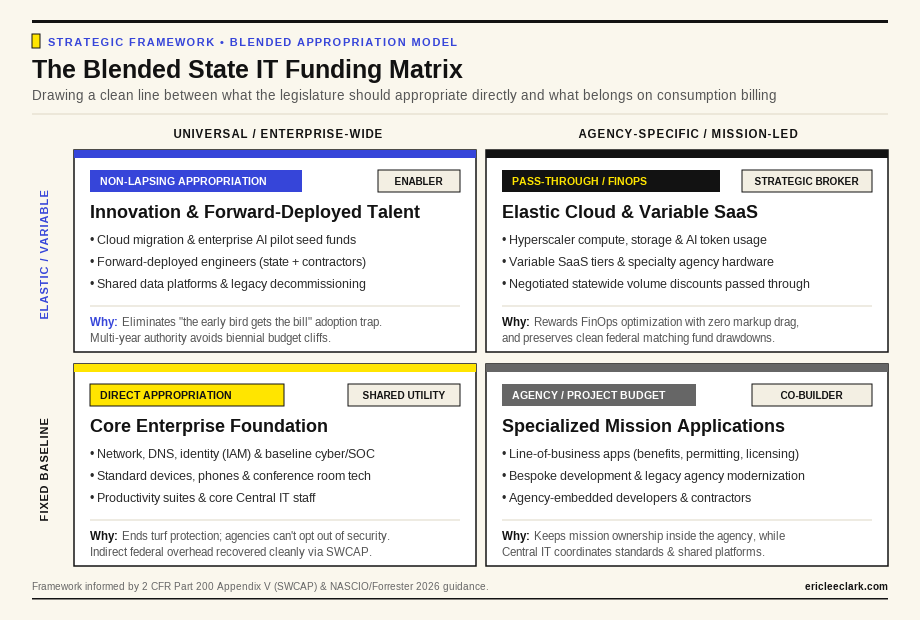
Draw a clean line between universal enterprise foundations and agency-specific consumption:
Look at what shifts culturally when you fund IT this way:
- Direct appropriations cover the core foundation. Networking, DNS, identity, baseline cybersecurity, enterprise telephony, standard employee devices and conference room tech, productivity suites, and core Central IT staff get funded directly, like a public utility. Agencies can’t opt out of security to balance a budget, and Central IT doesn’t have to defend turf to make payroll.
- Central IT becomes a strategic broker, not a markup reseller. For elastic cloud compute, storage, variable SaaS, or specialty agency hardware beyond the standard baseline, Central IT negotiates statewide volume discounts with hyperscalers and large vendors and passes them through transparently. Agencies get FinOps visibility, keep federal reimbursements intact, and actually save money when they optimize.
- Collaboration replaces friction with agency IT teams. Mid-sized and large agencies will always have their own developers, a mix of state employees and contractors who know their agency’s mission. Under heavy chargebacks, Central IT and agency IT feel like adversaries. Under a blended model, they co-build inside shared security guardrails.
- Appropriated funds fuel an innovation engine, including forward-deployed engineers. This is the part that gets me genuinely excited. AI gives states a rare shot to modernize legacy apps faster than ever and transform citizen services. Dedicating a slice of appropriated modernization funds to upskilling state technologists (paired with specialized contractors where needed) into forward-deployed engineers who embed alongside agency teams turns Central IT from a tollbooth into an enabler.
Pro Tip: Start With Showback Before Rewriting Rate Sheets
Changing statutory funds takes legislative patience. If you’re stuck inside a legacy chargeback model today, start with FinOps showback, giving agencies clear, real-time visibility into raw vendor costs versus internal overhead. Transparency builds the trust (and hard data) you’ll need when pitching a blended model to budget leaders.
Maximizing Every Taxpayer Dollar
Reforming state budget mechanics takes time. Go easy on the teams navigating these rules. They didn’t invent the funding structures they inherited.
And fixing the funding model is only half the story. As StateScoop highlighted from the 2026 NASCIO/Forrester report, “in the AI era, a two-year planning cycle can feel like two decades.” Even with smarter funding, legacy procurement still struggles with elastic cloud spend and unpredictable, token-based AI usage. (That’s a whole separate post I’ll dig into next.)
For now, the North Star is simple: structure state IT funding around maximizing taxpayer value, not protecting internal revenue streams. Appropriate the core foundation, broker elastic tech transparently, and invest in forward-deployed talent that helps agencies serve citizens better.
What do you think? If you work in state government IT (whether in Central IT, an agency shop, or a budget office), how is your chargeback model helping or hurting modernization? Drop your thoughts in the comments below!
Join the conversation